
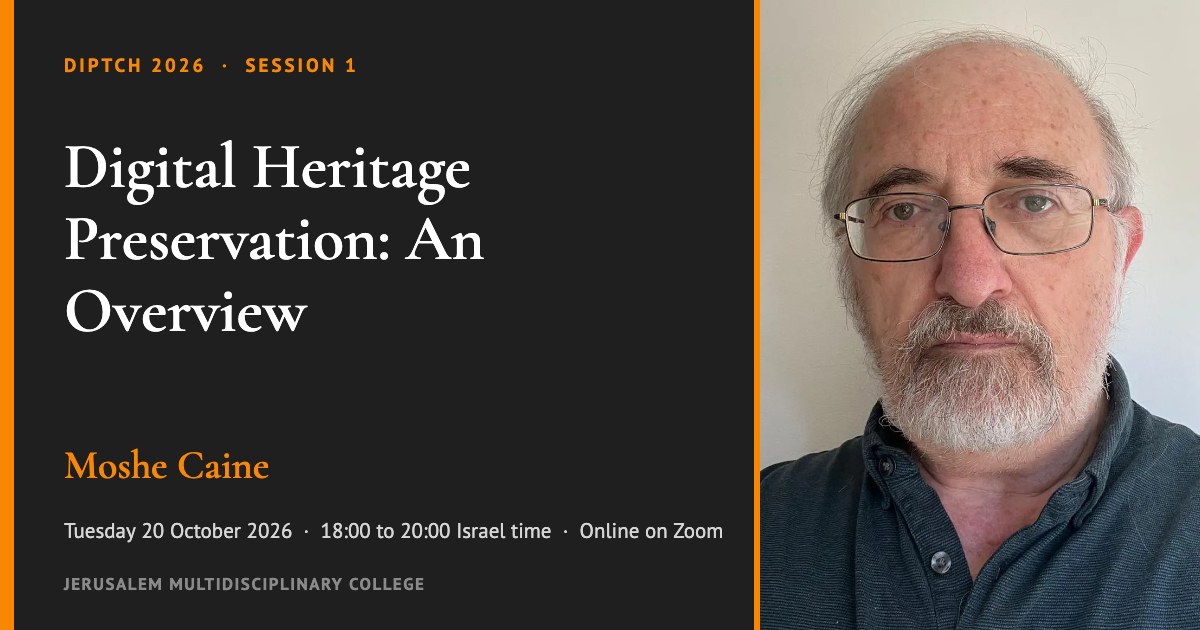
The opening session placed digital imaging within the wider work of preserving cultural heritage. Start with the key takeaways, then open any section below for the main ideas, the examples that were discussed, the techniques and terms, and links for going further. The case studies from Moshe’s own reading list are on his Suggested reading page.
Key takeaways
- Digital imaging serves four goals in cultural heritage: preservation, restoration, investigation and representation.
- Credibility comes first. Digital manipulation must not mislead, and added or restored material must be clearly distinguished from the original (Venice Charter, Article 9).
- Noninvasive documentation is the biggest advantage: heritage can be studied, measured and reconstructed without being touched.
- Techniques are strongest when combined: multispectral imaging, RTI, photogrammetry, LIDAR and Gaussian splatting each reveal something different.
- AI is both a promise and a risk for heritage. Responsibility is the safeguard, and the longevity of digital data remains an open problem.
How the course runs
Moodle handles attendance registration and Zoom access, while this website holds speaker profiles, assignments and technical guidance. The course is taught in English as part of the students’ degree program, which also allows guest lecturers and participants from several institutions to take part.
Four goals of digital imaging
- Preservation: preventing an object from deteriorating or becoming extinct, and allowing study without repeated exposure. Dead Sea Scroll fragments, for example, are so fragile that light, air or moisture can cause irreversible damage, so high-quality photography is a vital first step.
- Restoration: returning an object to an earlier state. Physical restoration relies on chemical and invasive techniques, while digital restoration is largely noninvasive; encrustation and blackening can hide original content, and digital methods can help recover it without touching the object.
- Investigation: extracting significant information through digital processing, such as revealing surface details, deciphering text and analyzing how a stone was worked.
- Representation: adapting how an object is presented to curators, researchers, museum visitors or publications. The manner of representation depends on both the objective and the audience.
Imaging represents an object; it does not replace the broader multidisciplinary work of preservation.
Integrity and transparency
- Credibility: the first and most critical rule. AI can now generate photorealistic images and editing tools allow seamless manipulation, so the risk of misrepresentation is real. An early example is the 1982 National Geographic cover on which the pyramids of Giza were digitally moved to fit the layout, which the magazine later acknowledged as a mistake. Article 9 of the Venice Charter (1964), one of the ICOMOS charters, holds that restoration must stop where conjecture begins and that any indispensable extra work must be distinct and bear a contemporary stamp. Keyword: Authenticity and integrity.
- Clear separation: added or restored information must be clearly distinguished from original material.
- Transparency: sources, databases, metadata and processing steps should be openly documented. Digital technologies suit this well, because they naturally leave a trail of processing data.
- Repeatability: other researchers should be able to reproduce the same results with the same parameters, which matters for monitoring deterioration over time and for comparing conservation outcomes before and after.
- Longevity: cuneiform tablets and Dead Sea Scroll fragments have survived thousands of years, while the survival of digital data over even 50 to 100 years is uncertain. Formats, data and metadata need continued attention. Keyword: Digital longevity.
What digital imaging makes possible
- Noninvasive documentation is the most important advantage: objects can be measured, viewed and explored from every angle without physical contact. Keyword: Non-invasive documentation.
- Documenting the inaccessible. Drones have transformed aerial documentation of large or hard to reach sites, and fragile fossil bones that broke when touched were modeled in 3D without contact.
- Reconstruction of destroyed heritage. Examples named were the Bamiyan Buddha statues (2001), the Mosul Museum (2014) and war damage in Ukraine. Crowdsourced photographs processed with modern algorithms can help rebuild lost objects, and earlier laser scans by Andrew Tallon supported the reconstruction of Notre Dame after the 2019 fire (GPS World report). Keyword: Reconstruction.
- Precision measurement. Scanning now exceeds what conventional methods can achieve, with uses in medicine, archaeology, architecture and art conservation.
- Duplication and 3D printing. Highly accurate replicas can be made, including tactile reproductions that let visually impaired people experience the form and structure of heritage objects. Keyword: Digital duplication and 3D printing.
- Archiving and sharing. Data can be converted into many formats and sent instantly, which feeds global repositories such as Europeana, the European Union portal to millions of digitized cultural items.
Techniques and terms
- Multispectral imaging. The visible spectrum spans roughly 400 to 700 nm. Infrared can reveal underpaintings, earlier sketches and changes in a composition, as in Van Eyck’s Arnolfini painting; in Munch’s The Scream it revealed a hidden inscription that handwriting analysis confirmed as Munch’s own. Ultraviolet can reveal varnishes, alterations, hidden signatures and possible forgeries. The Archimedes Palimpsest, a prayer book written over an earlier copy of Archimedes’ texts, was recovered with multispectral imaging, and the Dead Sea Scrolls are available in the Leon Levy Dead Sea Scrolls Digital Library. Keyword: Multispectral imaging.
- Decorrelation stretch. It amplifies subtle color differences that the eye cannot see, with particular uses in rock art and archaeology. Keyword: Decorrelation stretch.
- Reflectance Transformation Imaging (RTI). Photographs taken under changing light let the viewer relight an object interactively, revealing text, defects, scratches, grooves and surface topography; the relighting can be done in the studio after the photography. Example: engraved stones in the Church of the Holy Sepulchre. Learn more at Cultural Heritage Imaging. Keyword: RTI.
- Macro and micro photography, SEM and CT. These reveal coin blemishes, microscopic paint cracks, varnish bubbles and the interior of fossils and scrolls. The carbonized Herculaneum scrolls are now being read with synchrotron X-ray scanning and AI-assisted text recognition, which was once considered impossible (see the Vesuvius Challenge). Keyword: CT scanning.
- Gigapixel and 360 degree imaging. Gigapixel images allow interactive examination from the whole object down to fine detail; the session showed a wall of the Church of the Holy Sepulchre. Panoramic and 360 degree images create a spatial viewing experience that was described as 2.5-dimensional, because it remains two-dimensional. Keyword: Gigapixel and 360 degree imaging.
- Photogrammetry. A passive process that builds 3D models from overlapping photographs by triangulation. It scales from city-wide models to a 2.5 cm cylinder seal. Active scanning, by contrast, beams laser light at an object and measures what comes back. See Historic England’s guidance on photogrammetry. Keyword: Photogrammetry.
- Laser scanning and LIDAR. LIDAR measures distance by timing the return of infrared laser beams. Airborne LIDAR has revealed previously unknown Maya structures beneath jungle canopy in Guatemala and Mexico, and it is now built into consumer devices such as the iPhone Pro. See Historic England’s guidance on laser scanning. Keyword: Laser scanning and LIDAR.
- Rollout photography. It flattens a cylindrical object, such as a Greek vase, so that its full narrative can be seen in one image. Keyword: Rollout photography.
- Gaussian splatting. Presented as an emerging revolution in 3D imaging that can produce real-time 3D models from video footage; the foundational paper is Kerbl et al., 2023. Keyword: Gaussian splatting.
- Combining methods. The most powerful results often come from combining techniques, for example rollout photography with gigapixel imaging to reveal fine inscriptions on a column, or photogrammetry with decorrelation stretch.
- Augmented and virtual reality can present lost or inaccessible heritage in context, and AI reconstruction may combine photographs, diagrams, sketches, paintings and written descriptions.
- Beyond heritage. Infrared, ultraviolet, CT and RTI are also used in criminology, for example in analyzing shoe prints and related evidence.
Questions to carry forward
- Technology often arrives as an answer in search of a question, so it matters to know what you want to achieve before choosing a tool. Nobody could have asked whether carbonized scrolls could be read before the technology existed, and each answer raises new questions.
- AI is both a threat and a promise: it can help read damaged scrolls, reconstruct lost information and explain results to different audiences, while synthetic images put authenticity and trust at risk. A participant pointed out that worries about manipulated images are not new, since retouching glass plate negatives dates to the 1850s; the difference is the scale and sophistication of today’s tools. Responsibility was named as the key safeguard. Keyword: AI and heritage.
- As multimodal data combines geometry, imaging, text and AI, objects may eventually narrate their own stories in accessible language for any audience. Who owns heritage data, and who can reach it, will return in later sessions. Keyword: Data ownership and access.
- Later speakers will pick up several of these threads: Shai Halevi plans to present the Ein Gedi scroll and related projects (see Seales et al., 2016, Science Advances); Graham Diprose is scheduled to address the longevity of digital photographic prints; and Marinos Ioannides will speak on digital heritage.
Keywords for this session: Multispectral imaging · Decorrelation stretch · RTI · Photogrammetry · Laser scanning and LIDAR · Gaussian splatting · Gigapixel and 360 degree imaging · CT scanning · Rollout photography · Reconstruction · Non-invasive documentation · Digital duplication and 3D printing · Authenticity and integrity · Digital longevity · AI and heritage · Data ownership and access